

[ad_1]
Aligning massive language fashions (LLMs) with human values is crucial as these fashions turn into central to varied societal capabilities. A major problem arises when mannequin parameters can’t be up to date straight as a result of the fashions are mounted or inaccessible. In these instances, the main focus is on adjusting the enter prompts to make the mannequin’s outputs match the specified outcomes. Nonetheless, this system lacks a stable theoretical basis, and its effectiveness and skill to realize the most effective outcomes are unsure in comparison with strategies that regulate the mannequin’s parameters. The important thing concern is whether or not immediate optimization can absolutely deal with alignment challenges with out requiring direct changes to the mannequin itself.

Present strategies for aligning massive language fashions (LLMs), similar to reinforcement studying from human suggestions (RLHF), rely closely on fine-tuning mannequin parameters. These embody supervised fine-tuning, reward studying, and reinforcement learning-based optimization. Regardless of being environment friendly, they’re resource-intensive and thus unsuitable for frozen or inaccessible fashions. The brand new alternate options, specifically direct choice optimization and intuitive fine-tuning, depend on parameter updates, limiting their applicability scope. Not too long ago, immediate optimization was found as a substitute that interacts with the enter prompts to regulate the mannequin responses. This system doesn’t have a lot theoretical readability and has been topic to doubts over its means to match the efficacy of parameter-based strategies for alignment challenges.
To enhance the alignment of enormous language fashions (LLMs), researchers from the College of Central Florida, the College of Maryland, and Purdue College proposed Align-Professional, a immediate optimization framework designed to align LLMs with out modifying their parameters. This framework contains key steps similar to supervised fine-tuning (SFT), reward studying, and reinforcement studying (RL). The RLHF course of begins with SFT, which fine-tunes pre-trained fashions on human-generated datasets. Then, a reward mannequin is educated utilizing professional suggestions to guage mannequin responses, usually utilizing a pairwise comparability loss operate. The fine-tuning with RL maximizes alignment by fixing a KL-regularized optimization downside. By means of such iterative fine-tuning of the mannequin, mannequin parameters get adjusted to be aligned higher with human preferences. It fine-tuned a prompter mannequin to affect the responses that the mannequin generates. The framework explored how tuning parameters, such because the regularization coefficient (λ), managed the optimization’s extent, making certain environment friendly and computationally possible alignment.
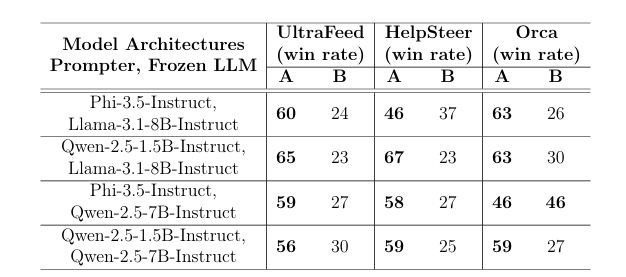
Researchers carried out experiments on the framework utilizing two prompter fashions, P1 (Phi-3.5-Instruct) and P2 (Qwen-2.5-1.5B-Instruct), together with two frozen fashions, F1 and F2 (each Llama-3.1-8B-Instruct). The analysis concerned three configurations: no fine-tuning, Align-Professional with a fine-tuned prompter, and RLHF with a fine-tuned mannequin. Efficiency was examined on three datasets: UltraFeedback, HelpSteer, and Orca, utilizing metrics like imply reward, variance, and win price comparability. Outcomes confirmed Align-Professional persistently outperformed the no fine-tuning baseline throughout all datasets and architectures, with improved imply rewards, decrease reward variance, and win charges as excessive as 67% (e.g., Qwen-2.5-1.5B-Instruct with Llama-3.1-8B-Instruct on HelpSteer) in comparison with the baseline. The outcomes identified that the optimization effectivity within the framework works via prompts with out altering the frozen fashions; standardized hyperparameters additional help environment friendly computational sources.
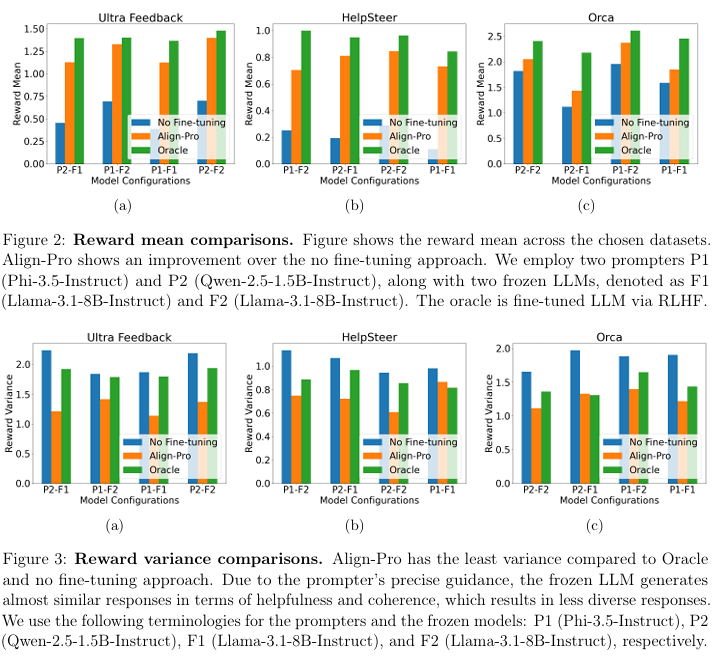
In conclusion, the proposed framework effectively optimized prompts utilizing a smaller, trainable mannequin to generate prompts for frozen massive language fashions. This decreased computational prices whereas retaining the LLM’s pre-trained capabilities. The framework outperformed baselines relating to imply rewards and win charges throughout varied datasets and configurations with out requiring fine-tuning of the LLM. This effectivity not solely reassures the practicality of the framework but in addition its potential to impression future analysis in AI and machine studying considerably. The framework generally is a baseline for future analysis, and attainable developments may embody analyzing the impression of noise on immediate robustness, sequential prompter designs, and growing theoretical bounds that enhance alignment efficiency in LLMs.
Take a look at the Paper. All credit score for this analysis goes to the researchers of this venture. Additionally, don’t overlook to comply with us on Twitter and be a part of our Telegram Channel and LinkedIn Group. Don’t Overlook to affix our 70k+ ML SubReddit.
🚨 [Recommended Read] Nebius AI Studio expands with imaginative and prescient fashions, new language fashions, embeddings and LoRA (Promoted)

Divyesh is a consulting intern at Marktechpost. He’s pursuing a BTech in Agricultural and Meals Engineering from the Indian Institute of Know-how, Kharagpur. He’s a Knowledge Science and Machine studying fanatic who needs to combine these main applied sciences into the agricultural area and clear up challenges.
[ad_2]
Source link


