

[ad_1]
Relationship consultants say that the honeymoon interval lasts about two years. After that, the newlywed sheen wears off, and what’s left is navigating the actual work of constructing a future collectively. The identical is now being mentioned about GenAI.
Nearly like clockwork, 30 months after ChatGPT broke into the mainstream, GenAI’s honeymoon with the media appears to be over. Headlines now trace at disappointment, with the tech supposedly sliding into the “trough of disillusionment.” The media reviews that enterprise leaders are questioning ROI, traders are anxious for earnings, and a rising variety of pundits counsel the know-how could have peaked — all earlier than it even acquired began.
On the identical time, the identical media that after portrayed OpenAI CEO Sam Altman as a generational visionary now finds him a divisive determine. His $6.4 billion acquisition of Jony Ive’s design agency is being dismissed as an excessive amount of Steve Jobs-ish and never sufficient sensible technique.
We’re utilizing outdated frameworks to guage a basically completely different form of innovation.
This type of scrutiny isn’t distinctive to Altman nor OpenAI. Historical past is filled with founders branded “troublesome” for refusing to just accept the established order on their strategy to transformative innovation. Steve Jobs was criticized as perfectionist micromanager. Jeff Bezos as autocratic and obsessive. Travis Kalanick was reviled for his aggressive techniques in constructing what has turn into a worldwide logistics platform. However none of them have been constructing typical companies; they have been constructing one thing that might compete with, change and reinvent the class.
The identical will be mentioned for Sam Altman and OpenAI. He isn’t constructing simply one other tech startup, and OpenAI isn’t simply one other software program firm. In 30 months, we’ve witnessed the evolution of a platform that turned “GPT” right into a verb and GenAI right into a globally and generationally understood idea.
In 2023, all of us Googled. In 2025, many people now GPT — even when we aren’t at all times utilizing OpenAI as our conversational interface.
But skepticism persists.
Why the disconnect?
A part of it might be that the dialog is being formed by the improper voices. Or that we’re utilizing outdated frameworks to guage a basically completely different form of innovation. Or maybe we’re simply not wanting on the information that actually issues.
Learn Extra: Utilizing the FIT Framework to Drive Success in a Digital 3.0 World
In the actual world — throughout industries, use instances and enterprise capabilities — we discover that GenAI is already delivering. And the folks saying so aren’t entrepreneurs or GenAI evangelists. They’re CFOs, the final word guardians of company spending and stewards of return on funding.
And at among the greatest corporations on the planet.
Out of the Mouths of the C-Suite
Our crew at PYMNTS Intelligence has been monitoring the adoption of GenAI since March 2024 by way of The CAIO examine —brief for “Chief AI Officer.” The title displays a perception that GenAI, just like the web earlier than it, will ultimately permeate each a part of the enterprise and turn into an embedded a part of actions and enterprise processes.
Learn Extra: From Spark to Technique: How Product Leaders Are Utilizing GenAI to Acquire a Aggressive Edge
Since its inception, the examine has captured insights from 60 C-suite executives every month, totaling almost 900 CFOs, COOs, and CPOs over a 14-month interval. Respondents are grouped into low-, medium-, or high-impact personas relying on how they deploy GenAI — from tactical one-off duties to enterprise-wide, strategic capabilities that affect enterprise outcomes.
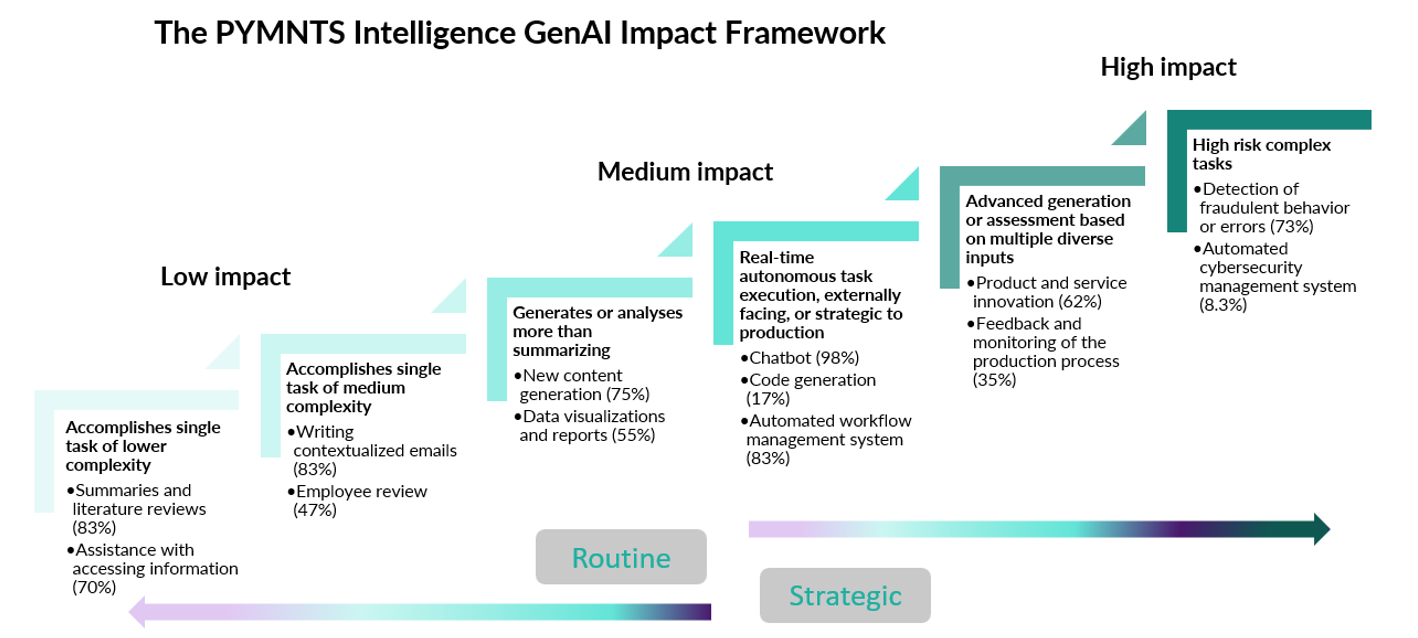
The developments are hanging.
By December 2024, 90% of CFOs on this benchmark examine reported a “very constructive” ROI from GenAI, up from simply 26% 9 months earlier. Three months later, that 90% determine held regular. And much more telling: not a single govt surveyed reported negligible ROI for 4 consecutive months.
This isn’t one-off optimism. That is data-proven momentum.
Cybersecurity and fraud, maybe not surprisingly, have seen essentially the most fast adoption. In March 2024, simply 28% of CFOs mentioned they used GenAI for fraud detection or cybersecurity administration. By December, that quantity jumped to 75%. In the identical interval, utilization of GenAI to establish fraud and errors rose from 27% to 72%. Extra telling, the CFOs who used GenAI to assist these actions discovered them much more impactful than merely fine-tuning across the edges of present processes and coaching, although many nonetheless cling to what was as soon as tried and true.
This isn’t one-off optimism. That is data-proven momentum.
Extra telling is that the share of organizations utilizing GenAI in high-impact methods has doubled over the previous yr. The best-ROI use instances are not pilot packages — they’re strategic imperatives embedded deep in enterprise operations.
And the way CFOs consider ROI isn’t the stuff of green-eye-shaded accountants seeking to tik and tie each expense to a demonstrable level of revenue on the steadiness sheet. As an alternative, it’s their remark of the strategic affect of the know-how on operational efficiencies and their potential to reallocate spend on account of utilizing it.
And it’s not stopping there.
Placing Cash The place the Efficiencies Are
By the tip of 2025, enterprise spending on GenAI is anticipated to extend by 50%. This isn’t throwing good cash at a know-how with eyes-closed and fingers crossed, hoping for the perfect. Our information present that 75% of corporations are accelerating their adoption of GenAI and 78% have elevated their funding in complicated, enterprise-grade use instances. These C-level resolution makers are redesigning core processes and infrastructure to leverage GenAI’s capabilities by making it part of how they do enterprise.
Shocking, even to us, is that the largest inner firm advocates are CFOs—the skilled skeptics everyone knows and love who usually say no earlier than they are saying sure.
The most important inner firm advocates are CFOs.
In line with our CAIO benchmarking information, 97% of CFOs mentioned they belief GenAI to assist threat administration, and 98% belief it to help in strategic decision-making. These CFOs are usually not utilizing the know-how to exchange human judgment; they’re augmenting it to assist groups make quicker, extra assured selections. And that may be a return on their investments in each {dollars} and human capital.
Maybe essentially the most highly effective indicator of GenAI’s traction is the truth that the share of CFOs reporting negligible ROI dropped from 20% in March 2024 to 0% by December. And it hasn’t budged since.
Learn Extra: Sensible Spending: How AI Is Remodeling Monetary Determination Making
From Prompts to Auto Pilot: The Agentic Shift
As headlines debate whether or not GenAI has peaked or whether or not it’s even price it, the truth is that it’s already evolving into the subsequent frontier. Agentic AI is when autonomous techniques function on behalf of people to execute complicated, multi-step duties. And it’s the pure evolution of the whole lot GenAI has enabled up to now.
Deloitte predicts that 25% of enterprises utilizing GenAI will implement agent-based techniques by the tip of this yr. That quantity is anticipated to double by 2027.
The truth is that GenAI is already evolving into the subsequent frontier.
The reality is that AI brokers are already stay within the wild — processing insurance coverage claims, monitoring affected person vitals, managing eCommerce operations and scanning for fee fraud in actual time. The use instances aren’t nearly tomorrow. They’re at the moment.
Commerce is an thrilling software of this tech however nearly absolutely isn’t the one transformational frontier.
Learn Extra: Visa Provides AI Procuring Brokers ‘Clever Commerce’ Superpowers
AI brokers that may search, examine, determine and transact, with out requiring the patron to be a part of the dialog, by no means thoughts shoulder the workload, have the potential to redefine how buying occurs, for customers and for companies.
Learn Extra: When Chatbots Exchange Search Bars, Who Wins at Checkout?
What The Subsequent 30 Months Might Deliver
What historical past tells us about innovation and its path is that it by no means occurs in a straight line or precisely as the unique PowerPoint decks describe. There’s at all times the preliminary spike of inflated expectations, adopted by the dip of disappointment when expectations and the maturity of the tech aren’t at all times aligned, after which the lengthy slog towards real-world adoption at scale and with earnings. There are at all times early adopters who need to be first and are completely happy to place up with the frictions of one thing that may be very new. The quick followers who wait a bit for the early potholes to get paved over and the laggards who at all times convey up the rear.
GenAI isn’t following the standard curve.
In a world the place this know-how transformation is shifting so quick, laggards could by no means be capable to catch up.
It’s not hamstrung by infrastructure limitations which have made prior transformative efforts sluggish, sloggy and buggy. It’s constructing on the cloud, on enterprise information techniques, on digital funds and on an always-connected world. That’s why its trajectory is steeper, its adoption quicker, its use instances extra transformational and its execution occurring at a faster tempo.
PYMNTS Intelligence finds that 78% of organizations now use GenAI in a minimum of one strategic enterprise perform — up from 55% only one yr earlier. Firms know there are nonetheless hurdles: governance, belief, information integrity, coaching and expertise. However they’re prepared to place within the work as a result of the choice is much worse.
The outdated worry of lacking out has been changed by a more recent, extra pressing worry: being left behind. There’s rising recognition that in a world the place this know-how transformation is shifting so quick, laggards could by no means be capable to catch up.
The Honeymoon Is Far From Over
Thirty months in the past, GenAI was a curiosity. A cool strategy to draft higher emails, summarize articles, draft social posts and even write job descriptions. Right this moment, it’s the invisible engine behind enterprise transformation. It’s powering selections, defending techniques, managing threat, and in lots of instances, driving development. And it’s accessible to everybody.
Not like those that fret about how far more work must be finished and the way imperfect it nonetheless is, I proceed to be amazed at how briskly and the way pervasive it now’s in so many client and enterprise interactions. The enterprise leaders began their GenAI journeys with function, have constructed belief and proceed to experiment. They started with slim duties and constructed towards broader outcomes, as our GenAI Framework depicts. They aligned their GenAI investments with strategic objectives to be taught the GenAI ropes.
The truth that simply three years in, we’re already having critical debates about its long-term financial and societal affect is an indication of success, momentum, scale. And permanence. Not disillusionment.
Look no additional than Google for proof. It took almost a decade for that crew to good the enterprise mannequin that turned a fledgling Stanford analysis mission into a worldwide promoting powerhouse. Right this moment, Google has arguably the strongest AI analysis bench on the planet. That features Nobel laureates and the crew that invented the transformer structure that underpins GenAI.
The critics calling this second a trough are utilizing the improper lens.
And but, in 2025, Google is being pressured to reply, to pivot, reframe and compete with a industrial GenAI product that didn’t exist three years in the past.
To me, that’s not a slowdown. That’s a gauntlet being thrown down. One which has the tech giants now on their collective heels operating exhausting to catch up. And new gamers rising with new and highly effective fashions with specialised use instances they now energy. The critics calling this second a disappointing trough are utilizing the improper lens. GenAI isn’t only a new know-how. It’s not just like the cloud. It isn’t like cellular. It’s quicker. It’s deeper. It’s leveraging many years of digital funding whereas laying the groundwork for a very completely different form of working system. One which doesn’t have to first rebuild all of the rails to ship actual change proper now.
So, quite than the tip of their honeymoon with GenAI, I see a number of enterprise leaders who would really like nothing greater than to stay fortunately ever after with it.
[ad_2]
Source link


