

[ad_1]
On the prime of many automation want lists is a very time-consuming activity: chores.
The moonshot of many roboticists is cooking up the right {hardware} and software program mixture so {that a} machine can be taught “generalist” insurance policies (the foundations and methods that information robotic habits) that work in all places, beneath all situations. Realistically, although, when you have a house robotic, you most likely don’t care a lot about it working in your neighbors. MIT Pc Science and Synthetic Intelligence Laboratory (CSAIL) researchers determined, with that in thoughts, to aim to discover a answer to simply practice sturdy robotic insurance policies for very particular environments.
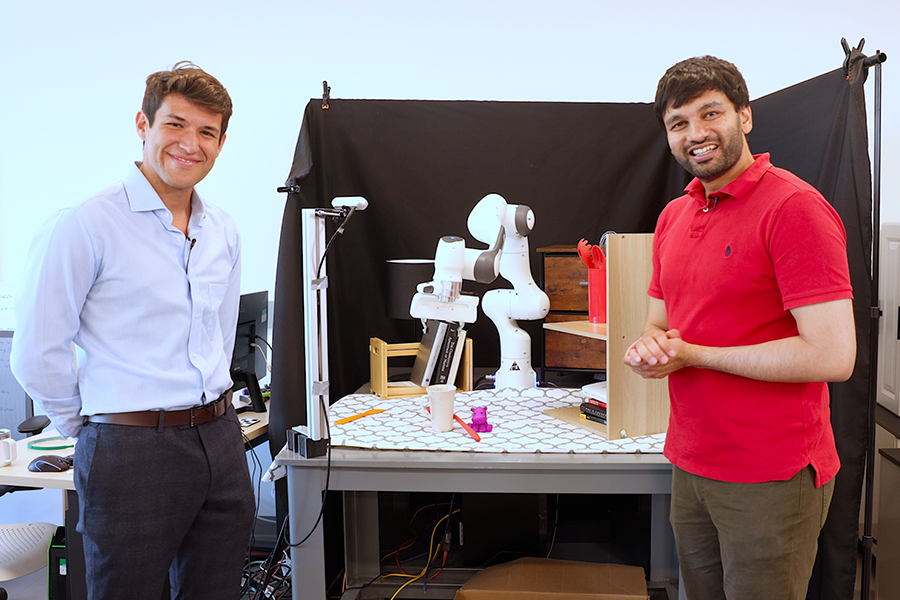
“We purpose for robots to carry out exceptionally effectively beneath disturbances, distractions, various lighting situations, and adjustments in object poses, all inside a single atmosphere,” says Marcel Torne Villasevil, MIT CSAIL analysis assistant within the Unbelievable AI lab and lead creator on a current paper concerning the work. “We suggest a technique to create digital twins on the fly utilizing the most recent advances in pc imaginative and prescient. With simply their telephones, anybody can seize a digital duplicate of the actual world, and the robots can practice in a simulated atmosphere a lot quicker than the actual world, due to GPU parallelization. Our method eliminates the necessity for in depth reward engineering by leveraging a couple of real-world demonstrations to jump-start the coaching course of.”
Taking your robotic house
RialTo, in fact, is a bit more difficult than only a easy wave of a cellphone and (growth!) house bot at your service. It begins through the use of your system to scan the goal atmosphere utilizing instruments like NeRFStudio, ARCode, or Polycam. As soon as the scene is reconstructed, customers can add it to RialTo’s interface to make detailed changes, add vital joints to the robots, and extra.
The refined scene is exported and introduced into the simulator. Right here, the purpose is to develop a coverage based mostly on real-world actions and observations, reminiscent of one for grabbing a cup on a counter. These real-world demonstrations are replicated within the simulation, offering some precious knowledge for reinforcement studying. “This helps in creating a powerful coverage that works effectively in each the simulation and the actual world. An enhanced algorithm utilizing reinforcement studying helps information this course of, to make sure the coverage is efficient when utilized outdoors of the simulator,” says Torne.
Testing confirmed that RialTo created robust insurance policies for a wide range of duties, whether or not in managed lab settings or extra unpredictable real-world environments, enhancing 67 % over imitation studying with the identical variety of demonstrations. The duties concerned opening a toaster, inserting a e book on a shelf, placing a plate on a rack, inserting a mug on a shelf, opening a drawer, and opening a cupboard. For every activity, the researchers examined the system’s efficiency beneath three growing ranges of problem: randomizing object poses, including visible distractors, and making use of bodily disturbances throughout activity executions. When paired with real-world knowledge, the system outperformed conventional imitation-learning strategies, particularly in conditions with a lot of visible distractions or bodily disruptions.
“These experiments present that if we care about being very sturdy to 1 explicit atmosphere, the perfect thought is to leverage digital twins as an alternative of making an attempt to acquire robustness with large-scale knowledge assortment in various environments,” says Pulkit Agrawal, director of Unbelievable AI Lab, MIT electrical engineering and pc science (EECS) affiliate professor, MIT CSAIL principal investigator, and senior creator on the work.
So far as limitations, RialTo presently takes three days to be totally skilled. To hurry this up, the staff mentions enhancing the underlying algorithms and utilizing basis fashions. Coaching in simulation additionally has its limitations, and presently it’s tough to do easy sim-to-real switch and simulate deformable objects or liquids.
The subsequent degree
So what’s subsequent for RialTo’s journey? Constructing on earlier efforts, the scientists are engaged on preserving robustness in opposition to numerous disturbances whereas enhancing the mannequin’s adaptability to new environments. “Our subsequent endeavor is that this method to utilizing pre-trained fashions, accelerating the training course of, minimizing human enter, and reaching broader generalization capabilities,” says Torne.
“We’re extremely obsessed with our ‘on-the-fly’ robotic programming idea, the place robots can autonomously scan their atmosphere and learn to resolve particular duties in simulation. Whereas our present technique has limitations — reminiscent of requiring a couple of preliminary demonstrations by a human and important compute time for coaching these insurance policies (as much as three days) — we see it as a big step in direction of reaching ‘on-the-fly’ robotic studying and deployment,” says Torne. “This method strikes us nearer to a future the place robots gained’t want a preexisting coverage that covers each situation. As a substitute, they will quickly be taught new duties with out in depth real-world interplay. For my part, this development might expedite the sensible utility of robotics far prior to relying solely on a common, all-encompassing coverage.”
“To deploy robots in the actual world, researchers have historically relied on strategies reminiscent of imitation studying from skilled knowledge, which may be costly, or reinforcement studying, which may be unsafe,” says Zoey Chen, a pc science PhD scholar on the College of Washington who wasn’t concerned within the paper. “RialTo straight addresses each the protection constraints of real-world RL [robot learning], and environment friendly knowledge constraints for data-driven studying strategies, with its novel real-to-sim-to-real pipeline. This novel pipeline not solely ensures secure and sturdy coaching in simulation earlier than real-world deployment, but additionally considerably improves the effectivity of knowledge assortment. RialTo has the potential to considerably scale up robotic studying and permits robots to adapt to advanced real-world situations rather more successfully.”
“Simulation has proven spectacular capabilities on actual robots by offering cheap, probably infinite knowledge for coverage studying,” provides Marius Memmel, a pc science PhD scholar on the College of Washington who wasn’t concerned within the work. “Nonetheless, these strategies are restricted to a couple particular situations, and developing the corresponding simulations is pricey and laborious. RialTo gives an easy-to-use device to reconstruct real-world environments in minutes as an alternative of hours. Moreover, it makes in depth use of collected demonstrations throughout coverage studying, minimizing the burden on the operator and lowering the sim2real hole. RialTo demonstrates robustness to object poses and disturbances, displaying unimaginable real-world efficiency with out requiring in depth simulator building and knowledge assortment.”
Torne wrote this paper alongside senior authors Abhishek Gupta, assistant professor on the College of Washington, and Agrawal. 4 different CSAIL members are additionally credited: EECS PhD scholar Anthony Simeonov SM ’22, analysis assistant Zechu Li, undergraduate scholar April Chan, and Tao Chen PhD ’24. Unbelievable AI Lab and WEIRD Lab members additionally contributed precious suggestions and assist in growing this venture.
This work was supported, partly, by the Sony Analysis Award, the U.S. authorities, and Hyundai Motor Co., with help from the WEIRD (Washington Embodied Intelligence and Robotics Improvement) Lab. The researchers introduced their work on the Robotics Science and Methods (RSS) convention earlier this month.
[ad_2]
Source link


